

The management of infectious healthcare waste is often viewed from the perspective of treatment. But even before discussing technology, one question deserves to be asked : Is it really necessary to transport the waste to its treatment facility?
Today, the traditional model relies primarily on off-site management: infectious waste is collected at the facility, temporarily stored, transported, and then treated at a specialized facility, typically through incineration.
On-site treatment offers an alternative approach : treating the waste directly where it is generated.
Two models, one fundamental difference
In the off-site model, the path of medical waste involves several stages between its generation and treatment: storage, collection, transportation, and treatment.
With on-site treatment, the waste is treated directly at the facility using appropriate equipment.
This difference, therefore, is not limited to transportation alone. It can have an impact on the environment, costs, and overall control of waste management.
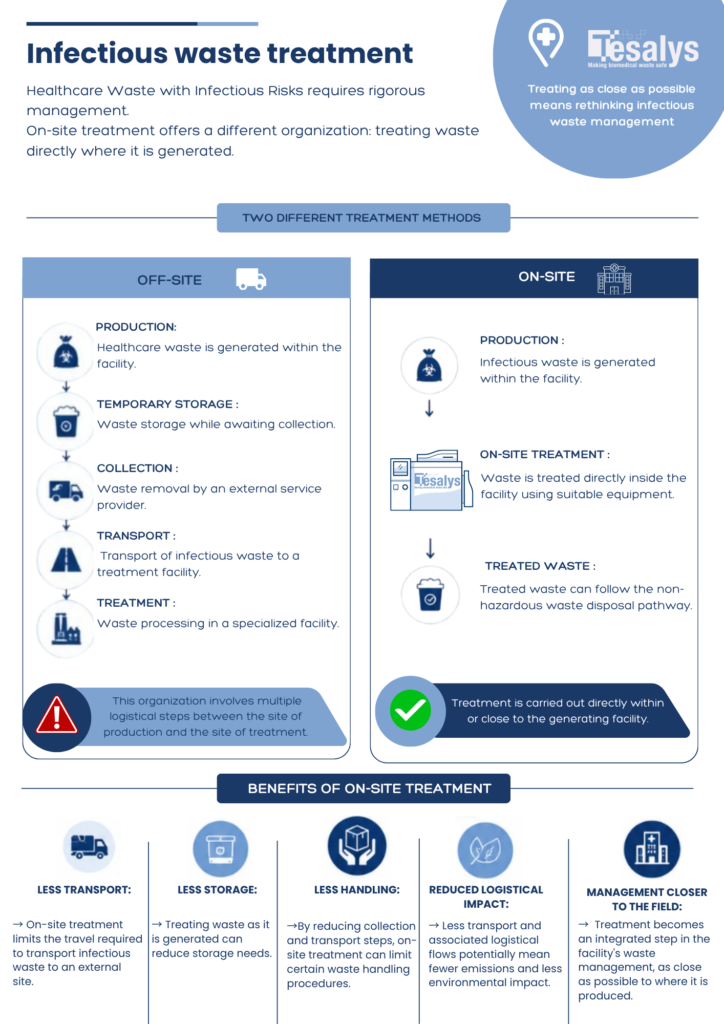
As this comparison shows, the difference between the two models is not limited to treatment technology. It also extends to organization, logistics, and, more generally, the economic and environmental impact of medical waste management.
An environmental issue that goes beyond transportation
Reducing transportation is an initial benefit, but it is only part of the equation.
Incineration itself is an energy-intensive industrial process that generates emissions. Life-cycle assessment studies show that, in certain healthcare waste management scenarios, incineration and transportation to treatment facilities contribute significantly to the overall environmental footprint.
On-site treatment allows for a rethinking of the entire chain : fewer logistics flows, treatment carried out as close as possible to the point of generation, and potentially more resource-efficient management, depending on the technology used and operating conditions.
This approach, therefore, goes beyond the simple issue of transportation : the goal is to reduce the impact of the waste’s entire journey.
Taking greater control of costs
Off-site waste management involves a series of services: collection, transportation and treatment.
For healthcare facilities, this also means relying on an external waste management chain and its economic conditions. Costs can vary depending, among other factors, on transportation distances and treatment arrangements.
On-site treatment changes this approach.
The healthcare facility invests in its own treatment equipment and turns part of the costs associated with an external service into operating costs that can be managed more directly.
Of course, an economic comparison should take the entire life cycle of the solution into account: investment, energy consumption, maintenance and operation.
In the long term, however, this approach can enable healthcare facilities to gain greater control over their budget and reduce their dependence on an external treatment chain.
Simpler, more integrated waste management
Beyond environmental and economic considerations, on-site treatment also changes day-to-day operations.
Treatment becomes an integrated part of the facility’s waste management process rather than being entirely outsourced to an external logistics chain.
Less temporary storage, fewer collection operations and treatment closer to the point of generation : on-site treatment brings infectious healthcare waste management closer to the people and operations on the ground.
What if the future of medical waste management was more local?
The issue is not necessarily about systematically opposing on-site treatment and incineration.
It is about asking whether all infectious healthcare waste needs to follow the same logistics chain before being treated, when solutions exist that can bring treatment closer to where the waste is generated.
For healthcare facilities looking to reduce their environmental impact, gain greater control over costs and rethink their waste management processes, on-site treatment is an alternative worth considering.
Treating infectious healthcare waste on site means going beyond waste treatment itself : it means rethinking its entire journey.