

Laboratories generate many types of waste every day, from contaminated tubes and gloves to sharps and microbiological cultures. Proper segregation and treatment are essential to protect staff, the environment and ensure safe waste management.
But what happens to infectious waste once it leaves the laboratory?
There are several steps involved — from segregation and temporary storage to collection, transport and treatment. And there is another question worth considering: what if this waste could be treated directly where it is generated?
How is infectious waste managed in laboratories?
The infographic below gives a simple overview of the different types of laboratory waste and the main steps involved in its management — from sorting at source to final treatment.
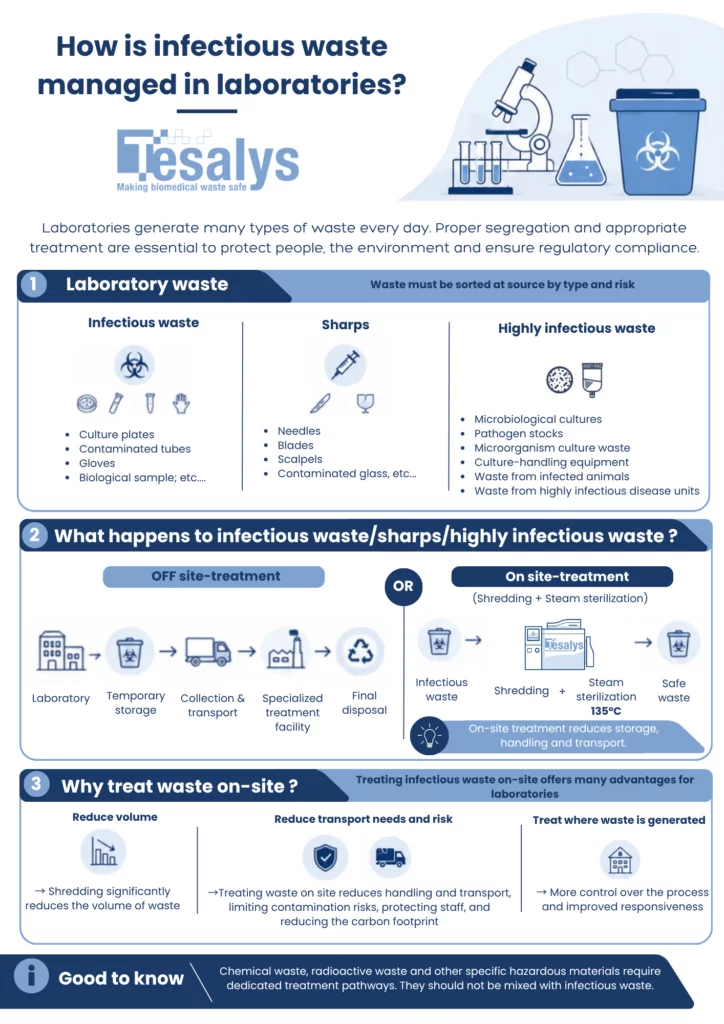
From segregation and temporary storage to collection, transport and treatment: understanding the different pathways for infectious laboratory waste.
As the infographic shows, waste management can follow a traditional off-site treatment pathway, or, for suitable infectious waste, an on-site treatment approach.
Waste must first be sorted at source
The first step takes place directly in the laboratory: waste must be sorted according to its type and risk.
Laboratories may generate different categories of waste, including:
- Infectious waste: contaminated tubes, gloves, culture plates, biological samples and other contaminated materials.
- Sharps: needles, blades, scalpels and contaminated glass.
- Highly infectious waste: microbiological cultures, pathogen stocks, microorganism culture waste, culture-handling equipment and waste from infected animals.


Proper segregation helps ensure that each type of waste follows the appropriate management and treatment pathway.
Chemical waste, radioactive waste and other specific hazardous materials require dedicated treatment pathways and should not be mixed with infectious waste.
Temporary storage
Once sorted, infectious waste may need to be stored temporarily before it is collected.
This step requires appropriate containers and dedicated storage conditions to limit exposure and prevent accidental contact with contaminated materials.
For laboratories using an external treatment service, storage is also part of the logistics chain between the point where waste is generated and the point where it is finally treated.
Collection and transport
In the traditional model, infectious waste is collected from the laboratory and transported to a specialised treatment facility.
The pathway can therefore involve several stages:
Laboratory → temporary storage → collection & transport → specialised treatment facility → final disposal.
Each additional step means more handling and logistics between the laboratory and the final treatment stage.
For laboratories located in areas where transport or waste infrastructure is limited, these logistical requirements can also become more complex.
What happens when infectious waste is treated off site?
At a specialised facility, infectious waste undergoes an appropriate treatment process designed to eliminate the biological risk before final disposal.
This centralised approach is widely used, but it means that the waste must first leave the laboratory and travel through the different stages of the external waste-management chain.
This raises another possibility:
Does infectious waste always need to leave the laboratory before it can be treated?
What if infectious waste could be treated on site?
For suitable infectious laboratory waste, another approach is possible: treating the waste directly where it is generated.
With an on-site system combining shredding and steam sterilization, waste can be treated within the laboratory or healthcare facility rather than being transported to an external treatment site.
The process involves two key steps:
Shredding
The waste is first shredded, significantly reducing its volume and preparing it for the sterilization stage.
Steam sterilization
The shredded waste is then exposed to steam at 135°C.
This treatment pathway transforms the infectious waste into safe waste, while significantly reducing its volume.
Why consider on-site treatment?
Treating infectious waste where it is generated can simplify the waste-management chain and reduce the need for external handling and transport.
The main advantages highlighted in the infographic include:
Less storage
Waste can be treated closer to the point where it is generated.
Less handling and transport
Reducing the number of steps between the laboratory and treatment can help limit handling and transport-related risks.
Reduced volume
Shredding significantly reduces the volume of the waste.
More control over the process
Treatment takes place where the waste is generated, giving the laboratory greater control and responsiveness in its waste-management process.
From a long waste chain to a local solution
Managing infectious laboratory waste is not only about how it is treated. It is also worth considering where treatment takes place.
The traditional model involves several stages before the waste reaches a specialised treatment facility. On-site treatment offers another approach: treating suitable infectious waste directly where it is generated.
The right solution depends on the type and quantity of waste produced, the laboratory’s activities, available space, local requirements and existing waste-management arrangements.
But in some situations, one question can make a difference:
What if treatment could start where the waste is generated?